




What Is the Role of the Hygrostat in a Dehumidifier?

Table of contents
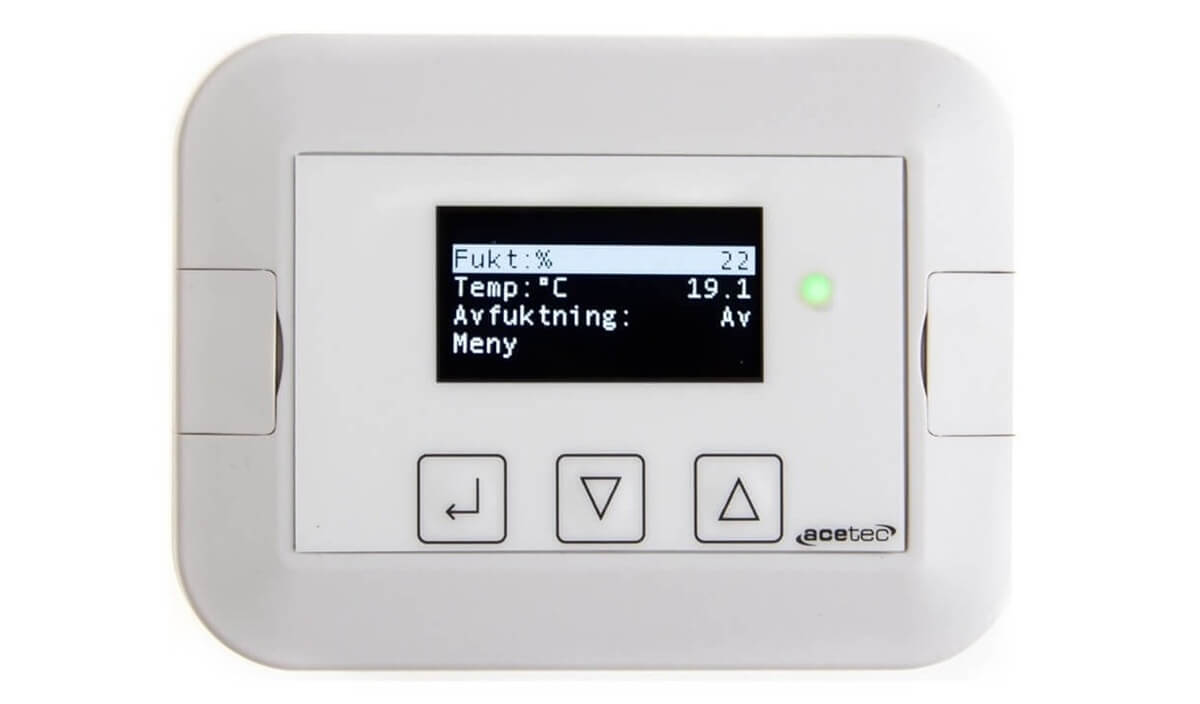
The hygrostat is a central part of Acetec desiccant dehumidifiers and controls when to dehumidify - neither too much nor too little. A humidity sensor built into the dehumidifier continuously measures the relative humidity, and the hygrostat uses the measured values to start and stop the dehumidifier at the right times. This provides a stable climate and low energy consumption.
When setting a desired relative humidity, If the dehumidifier has a ”set point”, the measured values from the humidity sensor in the dehumidifier are used to control the operation. The hygrostat compares the measured value with the setpoint and controls the dehumidifier accordingly. If the level rises above the set value, dehumidification starts, and when the air has become sufficiently dry, the dehumidifier returns to a sleep mode.
Hysteresis
To prevent the dehumidifier from switching on and off too often, there is a built-in control range, known as hysteresis. This means that the hygrostat does not react immediately to every small change in humidity, but works within a controlled range.
Example: If the setpoint is set to 62%, the dehumidifier is activated when the humidity rises to approximately 64 % and switches off again at approximately 60%. This provides stable control without unnecessary start and stop cycles, depending on the control range of the model.
Different hygrostats
There are several types of hygrostats, and they differ in technology, sensitivity and reliability. The choice affects the accuracy of humidity control, especially in colder environments.
Hair Hygrostat
The classic hair humidifier uses a hair strand that reacts to moisture by stretching or contracting. The movement affects a simple mechanical switch which in turn activates or stops the dehumidification.
The technology works, but is sensitive to temperature changes and can give misleading results in cold spaces. This type of hygrostat is therefore most common in warm indoor environments and simple applications.
Digital Hygrostat
Digital hygrostats use electronic humidity sensors to measure humidity and control the dehumidifier with high precision. The most reliable models have an accuracy of around ±2 % RH, making them suitable even in cooler environments, such as crawl spaces and cold attics.
Our digital hygrostats use electronic humidity sensors with high measurement accuracy (±2 % RF), low long-term drift and fast response time. The sensor performs the actual measurement, while the hygrostat uses the sensor signal to control the dehumidifier. The sensor is temperature compensated, factory calibrated and protected against dust and condensation, making the system both durable and virtually maintenance-free.
Difference Between a Hygrometer and a Hygrostat
It is easy to confuse the terms hygrometer and hygrostat, but they have different purposes.
In hygrometer is a pure measuring instruments which shows how humid the air is, for example in per cent relative humidity (% RH). It is used to monitor the climate, but does not affect anything itself.
A hygrostat, on the other hand, is a steering component. It receives readings from a humidity sensor and uses them to control other equipment - for example, a dehumidifier, a fan or a ventilation unit. When the humidity exceeds the set value, it activates connected equipment, and when the level drops, it switches off.
In short: the hygrometer displays the value, while the hygrostat acts on it.
More advanced hygrostats
More advanced hygrostats take into account more factors than just relative humidity. Our EvoDry RCF dehumidifiers, for example EvoDry RCF 12 G1 or EvoDry RCF 20 G1, uses governance based on both air humidity and temperature. This allows the dehumidifier to work more demand-driven and energy efficient.
Benefits of Mould Index Control
As mould grows more slowly at low temperatures, the control can allow slightly higher relative humidity during cold periods, such as winter. This means that the dehumidifier does not have to work unnecessarily, saving both energy and operating hours.
Therefore, in crawl spaces and cold attics, a desiccant dehumidifier that takes into account both temperature and humidity should be chosen.
Placement and Measurement
For the most accurate measurement, the humidity sensor in the dehumidifier should be positioned so that the air passing through the sensor reflects the conditions of the entire space. Avoid placing a sensor next to walls, near floors, vents, or in direct sunlight, as this can affect the readings.
In many dehumidifiers, the hygrostat with associated sensor is built in. In order for the measurement to be correct, it is important that air can pass freely past the sensor. Otherwise, blockages or unfavourable placement can lead to misleading values and poorer control.
Maintenance
Dirt and dust can affect measurements, especially in digital humidity sensors. Cleaning the dehumidifier regularly, for example with light vacuuming, and changing the filter at the inlet twice a year will ensure that it works efficiently and reliably.
All sensors may start to show minor deviations over time. Therefore, once a year it is good to compare the values with a separate hygrometer to check that the measurement is still accurate.


