




High Indoor Humidity: Common Causes

Table of contents
Managing indoor humidity is a natural part of looking after your home, whether you live in an older house or a modern apartment. By understanding how moisture works, you can easily create an environment that feels light and comfortable, while protecting the building's structure and materials.
However, it is worth noting that humidity challenges are rarely about the air in the whole room. In many cases, situations arise locally when warm and humid air meets cooler parts of the building where condensation can form.
To maintain a good balance in the home, it is therefore useful to understand what levels are appropriate, why variations occur and what measures contribute to a stable indoor environment.
What does humidity mean?
Humidity is measured in relative humidity (RH) and is expressed as a percentage. It shows how much moisture the air contains in relation to the maximum amount of moisture it can carry at a given temperature.
As warm air can carry more moisture than cold air, the relative humidity changes when the temperature changes - even if the actual amount of moisture in the air remains the same.
In dwellings, a normal and balanced level is often between 40-60% RH. When the level remains above about 65-70% for long periods, it is good to pay extra attention to ventilation, especially in cooler areas.
What humidity is balanced indoors?
| Relative humidity (RH) | Assessment | Listing |
|---|---|---|
| Under 30% | Very dry air | Common during cold winter periods; can be noticed on static electricity |
| 30-40% | Dry air | A normal level in Sweden for much of the heating season |
| 40-60% | Balanced level | Provides good living comfort and is gentle on furnishings and materials |
| 60-75% | Higher moisture level | Here you should pay extra attention to ventilation and cold surfaces |
| About 75% | High level | At these levels over time, measures to reduce moisture should be considered |
How to measure humidity
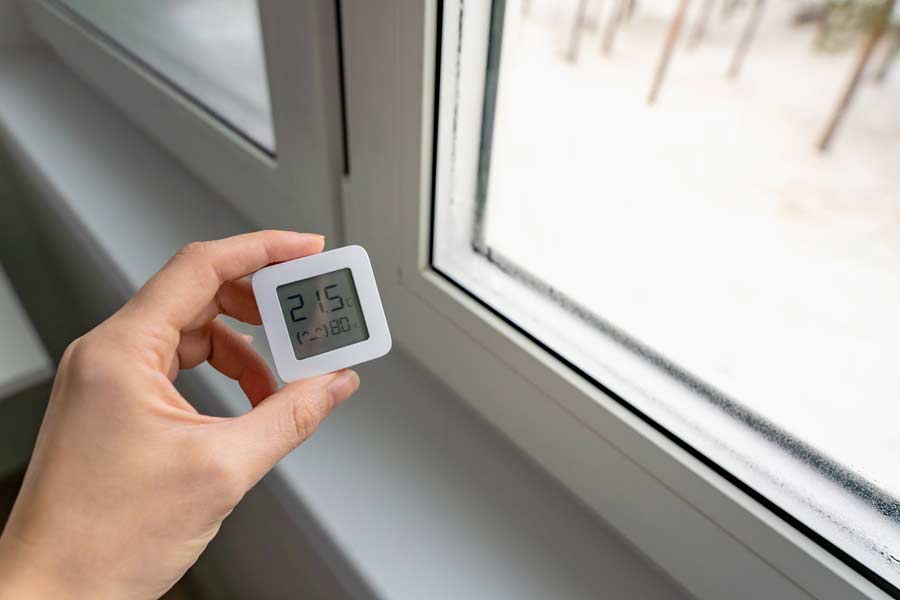
It often starts with measuring to get a clearer picture of the moisture balance in your home. A simple first step is to use a hygrometer, which shows the relative humidity in per cent.
Place the hygrometer in the so-called occupied zone - preferably at chest height in the room where you spend most time. Avoid placing it directly next to windows, exterior walls, radiators or in direct sunlight, as localised temperature changes can give misleading readings.
To get a more accurate picture, it may be interesting to observe the values at different times, for example:
- After a shower or bath when moisture is added quickly
- When cooking that creates water vapour
- During the summer, when the hot and humid outdoor air gets in
- In spaces that require extra supervision, such as basements, crawl spaces or cold attics
A simple hygrometer gives a good indication for home use. If a more in-depth analysis is needed or if there are recurring concerns, it may be wise to use calibrated equipment or to consult a professional for a ventilation check.
Common signs that moisture levels need to be reviewed
- Condensation on the inside of windows (especially at the bottom)
- Imma that lingers on bathroom mirrors after use
- A feeling that the air is heavy or confined
- Moisture accumulating in corners, behind large furniture or in places where air circulation is restricted
These signs are often more noticeable in late summer when warm outdoor air meets cooler spaces like basements or crawl spaces.
Why does the humidity in your home change?
1. Ventilation capacity
If the air is not replaced at a sufficient rate, the natural moisture from everyday life stays in the home for longer than desirable.
2. The meeting of hot and cold
When warm, moist air meets cold surfaces, condensation forms. This happens most often:
- On window panes during cold winter days
- In cool basement spaces during summer
- Against walls with a lower degree of insulation
3. Everyday activities
It is natural for a family to add between 5-10 litres of moisture per day through activities such as cooking, washing, plants and exhaled air.
4. Soil moisture and construction
Some parts of the house, such as crawl spaces or cold attics, are more affected by the surrounding environment and may require a little more care in terms of insulation and ventilation.
5. Modern and well-insulated houses
Today's airtight houses save energy, but require more balanced ventilation to remove excess moisture.
Caring for the house in the long term
When moisture levels are high for prolonged periods, it is wise to act to maintain the good condition of materials. This mainly involves preventing moisture from adhering to organic materials, as this ultimately affects living comfort.
Challenges often arise not in the centre of the room, but at so-called cold bridges - places where the surface is colder than the surroundings. This can happen, for example:
- Around window frames and doors
- In corners where two outer walls meet
- For balcony attachments or cooler wall sections
- Behind large furniture placed tightly against an outer wall
Paying attention to these places and ensuring that air can circulate freely creates favourable conditions.
Possible consequences of imbalance:
- Surface impact and microbial odour
- Impact on wooden structures, such as joists and/or blind bottoms
- Discolouration on walls and ceilings
- A perception that the air feels less fresh
- Increased presence of particles in indoor air
How to maintain a good moisture balance?
1. ensure proper ventilation
Effective ventilation replaces moist air with fresh outdoor air. For villas, an FTX unit can be an excellent solution that contributes to:
- A controlled and even air circulation all year round.
- Effective removal of excess moisture.
- Filtered supply air and good heat recovery.
2. use exhaust air actively
It's a good idea to leave the bathroom fan or kitchen fan running for a little extra time after use to help get the moisture out of the house.
3. Small adjustments in everyday life
Use lids when cooking and try to avoid drying laundry indoors if the ventilation is not designed for it.
4. Ventilate with care
A quick and intense cross-draft for a few minutes is often more effective than leaving a window ajar for a long time. It effectively exchanges the air without cooling down the materials in the room. In homes with functioning mechanical ventilation, this is often done automatically.
5. Supplement with a dehumidifier
In spaces where ventilation is insufficient, a dehumidifier be a very helpful complement:
- Condensation dehumidifiers - works well in heated environments, such as laundry rooms or basements above 15°C.
- Desiccant dehumidifiers - the most efficient choice for cooler spaces such as crawl spaces, garages and cold attics.


