




The Villa Effect 2026: How the energy efficiency grant works

Table of contents
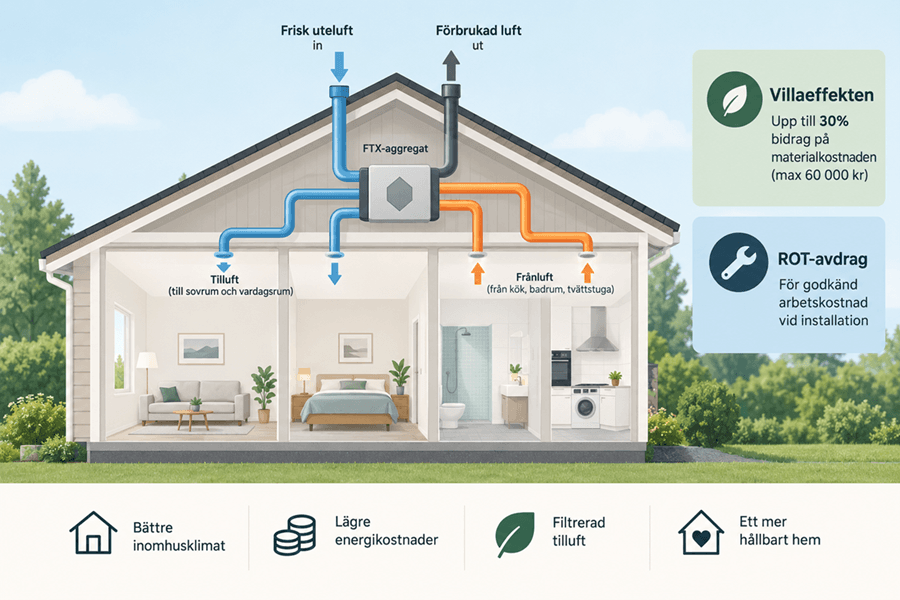
The ‘Villa Effect’ is the name given to the government’s the grant for energy efficiency improvements in detached houses. From 1 September 2026, owners of detached houses who meet the criteria will be able to apply for grants for a range of energy-efficiency measures. One of the measures explicitly covered is installation of FTX ventilation.
The grant can cover up to 30% of the cost of materials required for the work, with a maximum grant of 60,000 kronor per detached house. Labour costs are not included in the Villaeffekten scheme.
For anyone already considering installing FTX, the grant could have a significant impact on the investment calculations. However, the grant should not be viewed as an automatic discount. It is the County Administrative Board that assesses each application and decides whether to award the grant.
The Villa Effect in a nutshell
- FTX ventilation is one of the measures covered.
- The grant is capped at 30% of the approved cost of materials.
- The maximum grant is 60,000 kronor per detached house.
- Grants of less than 10,000 kronor will not be paid out.
- The cost of materials must therefore be at least 33,334 kronor.
- The house must have been built before 1990 and be used as a permanent residence.
- The property must not already be connected to a district heating network.
What is the Villa Effect?
The Villa Effect is a grant designed to facilitate energy efficiency improvements in older detached houses. Its official name is the grant for energy efficiency improvements in detached houses.
The grant is aimed at homeowners who carry out measures that can reduce a building’s energy requirements or make energy use more efficient. In addition to FTX, this includes, amongst other things, certain heat pumps, water-based heating systems, additional insulation, draught-proofing, and the improvement or replacement of windows and doors.
It is possible to apply for one or more approved measures. However, the total grant may not exceed 60,000 kronor per detached house. Grants may be awarded on no more than two occasions, and any support paid out during the previous grant round (2023–2025) is included in the maximum amount.
Does FTX ventilation fall under the Villa Effect?
Yes. The National Board of Housing, Building and Planning explicitly states that installation of a supply and extract air ventilation system with heat recovery, FTX, is an eligible measure.
An FTX system creates a controlled air exchange within the house. Stale air is extracted from areas such as the kitchen, bathroom and utility room, whilst filtered outdoor air is supplied to the bedrooms and living room. In the unit’s heat exchanger, a large proportion of the heat from the exhaust air is transferred to the incoming supply air, without the air streams mixing.
Compared with natural draught or purely mechanical extract ventilation, FTX offers better control over airflows and makes it possible to recover heat that would otherwise have been vented out.
The choice of unit needs to be tailored to factors such as the size of the house, its floor plan, air flows and the space available for installation. See our range of FTX unit for detached houses and smaller properties.
Who is eligible to apply for the grant?
In order to qualify for the Villa Effect, both the applicant and the property must meet certain basic conditions.
- You must own all or part of the detached house.
- The house is to be used as a permanent residence.
- You must normally be registered as living at that address.
- You must be permanently resident in the house by the time you apply for payment.
- The house must have been valued before 1990.
- The property must not already be connected to a district heating network.
The term ‘detached house’ refers to single-family and two-family dwellings. This may be a detached house, but it may also be a semi-detached house, a terraced house or a row house. Holiday homes are not included, as the property must be used as a permanent residence.
The year of valuation is not always the same as the year of construction
A common misconception is that the house’s original year of construction alone determines whether it is covered. Instead, the criterion is the property’s valuation year.
The valuation year is the year in which the building is deemed to have been constructed for the purposes of property valuation. This often corresponds to the year of construction, but may have been brought forward following a major extension or refurbishment. This information is normally included in the Swedish Tax Agency’s property valuation decision. Further information and relevant online services are available at The Swedish Tax Agency’s page on property valuation.
A house that was originally built before 1990 may therefore have a later valuation year. It is therefore advisable to check the property valuation before planning an FTX project based on the grant.
How much can you receive in grants?
The ‘Villa Effect’ scheme can provide a grant of up to 30% of the cost of the materials which the County Administrative Board deems necessary for the implementation of the measure. The maximum grant is 60,000 kronor per detached house.
No grant will be awarded if the estimated amount is less than 10,000 kronor. This means that the total approved cost of materials must be at least 33,334 kronor.
| Approved cost of materials | Potential grant |
|---|---|
| 33,334 SEK | Around 10,000 SEK |
| 37,587.50 SEK | Approximately 11,276 SEK |
| 50,000 SEK | 15,000 SEK |
| 100,000 SEK | 30,000 SEK |
| 200,000 SEK | 60,000 SEK, which is the maximum amount |
The figures in the table are illustrative examples. The final grant amount depends on the material costs approved by the County Administrative Board. The total investment is also affected by factors such as the size of the building, ductwork, installation conditions and the choice of unit. Read more about how much FTX ventilation costs and which factors affect the final price.
What can be classified as ‘material’ in an FTX system?
The grant does not apply to an arbitrary proportion of the project’s total cost. It applies to materials deemed necessary for the implementation of the approved energy efficiency measure.
The Swedish National Board of Housing, Building and Planning describes, amongst other things, the following as the main components of an FTX system:
- heat exchanger;
- ventilation ducts;
- fans;
- filter;
- control and regulation systems.
In a real FTX installation, other items may also be required, such as duct sections, diffusers, silencers, insulation and fitting materials. However, it is the County Administrative Board that determines which costs may be included in the basis for the grant.
To facilitate the assessment, a quotation and subsequent invoice should clearly distinguish between:
- FTX units;
- other items of materials;
- labour costs;
- travel and transport;
- machinery, design work and other costs.
An unspecified total amount makes it more difficult to see which part relates to material eligible for a grant and which part may form the basis for ROT.
What are the requirements for the products?
Products used in the project must be energy-efficient. The National Board of Housing, Building and Planning may require the applicant to provide evidence of the product’s characteristics and, where applicable, its energy class.
When planning an FTX installation, it is therefore important that technical documentation is available for the unit in question. Among other things, the documentation should make it possible to identify the product, its energy performance and relevant technical characteristics.
The choice of unit should, at the same time, be based on the building’s actual requirements. Living space, floor plan, design airflow, available duct pressure, noise requirements and location all influence which unit is suitable. A larger unit is not automatically better, and a unit that is too small risks having to work unnecessarily hard.
ROT tax relief for the installation – can it be combined with the ‘Villaeffekten’?
Yes. The ‘Villa Effect’ and the ROT tax relief apply to different parts of the investment. According to The Swedish National Board of Housing, Building and Planning’s conditions for the ‘Villa Effect’ The grant covers the cost of necessary materials. The ROT tax relief may instead be used for that part of the installation which constitutes eligible labour costs, provided that the conditions for the respective scheme are met.
In 2026, the company may deduct a maximum of 30% from the approved labour cost stated on the invoice. On The Swedish Tax Agency’s website the current list of works that may be covered is available.
For a more practical guide to the requirements for ventilation work, you can read our article on ROT tax relief for ventilation and installation.
The following applies to the ROT tax relief, amongst other things:
- the deduction applies only to approved labour costs;
- materials, travel, equipment and administration do not qualify for tax relief;
- the customer is to own and use the property;
- the customer must have sufficient tax against which to offset the reduction;
- the company carrying out the work must normally be registered for F-tax;
- the payment must be traceable electronically;
- The customer must still have some ROT allowance remaining during the year.
The maximum ROT tax relief is 50,000 kronor per person per year. The combined total of ROT and RUT may not exceed 75,000 kronor per person per year.
It is the installation company that applies the ROT tax deduction on the invoice and then applies to the Swedish Tax Agency for payment. The homeowner applies for the ‘Villaeffekten’ scheme themselves, and the application is assessed by the county administrative board.
Calculation example: The ‘Villa Effect’ and the ROT tax deduction
One possible starting point for the calculation is a wind turbine such as the EvoAir A100S G3 at a price of 37,587.50 SEK. The calculation assumes that the entire amount is regarded as a necessary and eligible material cost.
- Cost of materials: 37,587.50 SEK
- The Villa Effect, 30%: approximately 11,276 SEK
- Cost of the product after any subsidy: approximately 26,312 SEK
In this example, the unit exceeds the minimum material cost required for the grant to amount to at least 10,000 kronor.
In a complete installation, additional system components are normally required. If these components are also deemed necessary and eligible for a grant, the basis for the grant may be increased.
Example involving installation costs and ROT
Assume also that the approved labour cost for the installation is 30,000 kronor. At the 2026 ROT rate, the deduction may amount to a maximum of 30% of the approved labour cost.
| Cost | Price before subsidies or deductions | Possible support or deductions |
|---|---|---|
| FTX aggregates and eligible materials | 37,587.50 SEK | Approximately 11,276 SEK through Villaeffekten |
| Approved labour costs | 30,000 SEK | 9,000 SEK through the ROT tax deduction |
| In total | 67,587.50 SEK | Approximately 20,276 SEK |
In this simplified example, the customer’s cost amounts to approximately 47,312 kronor after any grant and the ROT tax deduction.
This example assumes that the entire cost of materials is eligible under the Villaeffekten scheme and that the full amount of 30,000 kronor constitutes eligible labour costs for the ROT tax deduction. An installation invoice may also include travel, machinery costs, administration and other items that do not qualify for the ROT tax deduction.
How to apply for the Villa Effect
Applications are processed and decided upon by the county administrative board in the county where the property is situated. At The Swedish National Board of Housing, Building and Planning’s website on the ‘Villa Effect’ Up-to-date information is available on which application route to follow and which forms to use.
1. Check that the property meets the basic requirements
Start by checking the ownership details, permanent residence status, valuation year and whether the house is connected to district heating. The property’s valuation year is normally stated in the property valuation notice.
2. Draw up a detailed quotation
The quotation should set out the work to be carried out and clearly distinguish between the costs of materials, labour and other costs. Please also request a technical data sheet and information on the energy rating where applicable.
3. Apply within the specified time limit
Applications must normally be submitted within six months of the start of the project, and no later than 1 June 2030.
A project is deemed to have commenced when the installation of the eligible materials begins. Design work, the preparation of quotations and other preparatory work do not count as the project having commenced.
A specific deadline applies to measures commenced between 17 October 2025 and 31 August 2026. In such cases, the application must be submitted by 28 February 2027 at the latest.
Furthermore, the materials must have been ordered on or after 17 October 2025. You should therefore keep your order confirmations, order documents and receipts.
4. Attach the correct documentation
If the installation has not been completed when you submit your application, you will normally need to enclose:
- technical specification or product information sheet;
- information on the energy class, where applicable;
- detailed quotation or purchase order;
- supporting documentation showing which costs relate to each material.
If the installation has already been carried out, you will normally also need to attach invoices or receipts. It must be clearly stated which costs relate to materials and which to labour, as well as when the work began and was completed.
5. Request payment once the work is complete
The grant is not paid out simply because the application has been approved. Once the work has been completed, the homeowner must also request payment and provide a statement of the final costs.
If the measure has already been fully implemented when the application is submitted, the application and the request for payment may, in certain cases, be made as part of the same process.
Can several energy-saving measures be combined?
It is possible to apply for the Villaeffekten scheme for one or more approved measures. For example, a homeowner can combine FTX with additional insulation or the replacement of windows and doors, provided that each measure meets the requirements.
This may be relevant if the cost of materials for an individual measure does not reach the threshold of 33,334 kronor. Approved material costs from several measures may be included in the same application, but the total grant must still not exceed 60,000 kronor per detached house.
Frequently asked questions
Is the subsidy guaranteed when you buy an FTX unit?
No. The fact that FTX is included among the approved measures does not mean that every purchase automatically entitles the purchaser to a grant. The property, the applicant, the products, the costs and the deadlines must all meet the conditions. The County Administrative Board makes the final decision.
Does the ‘Villa Effect’ apply when replacing an existing FTX unit?
Information from the National Board of Housing, Building and Planning states that the installation of an FTX system is an eligible measure for a grant. In the case of a completely new installation, the eligibility is clear. If the project only involves replacing a unit in an existing system, the homeowner should check the eligibility criteria with the county administrative board before placing an order. The assessment may depend on the scope of the project and whether the measure meets the conditions set out in the regulation.
Can you install the system yourself and still be eligible for a grant?
The Swedish National Board of Housing, Building and Planning states that there is, in itself, no obstacle to receiving a grant towards the cost of materials if the homeowner carries out the work themselves. Building regulations, electrical safety requirements and other technical requirements must still be complied with. Carrying out the work yourself does not entitle you to the ROT tax deduction.
Can you claim ROT tax relief on the full installation cost?
No. The ROT scheme applies only to the part that constitutes eligible labour costs. Materials, travel, administration, machinery costs and other associated costs are not covered. The invoice should therefore be clearly itemised.
When must the application be submitted?
Applications must normally be submitted within six months of the start of installation, and no later than 1 June 2030. For measures commenced between 17 October 2025 and 31 August 2026, the deadline for applications is 28 February 2027.
What happens if we run out of money this year?
The grant is scheduled to run until the end of 2030, and applications are processed on a first-come, first-served basis. An application may therefore be submitted in one year and funded from the allocation for a subsequent year. However, the submission of an application does not guarantee that a grant will be awarded.

