




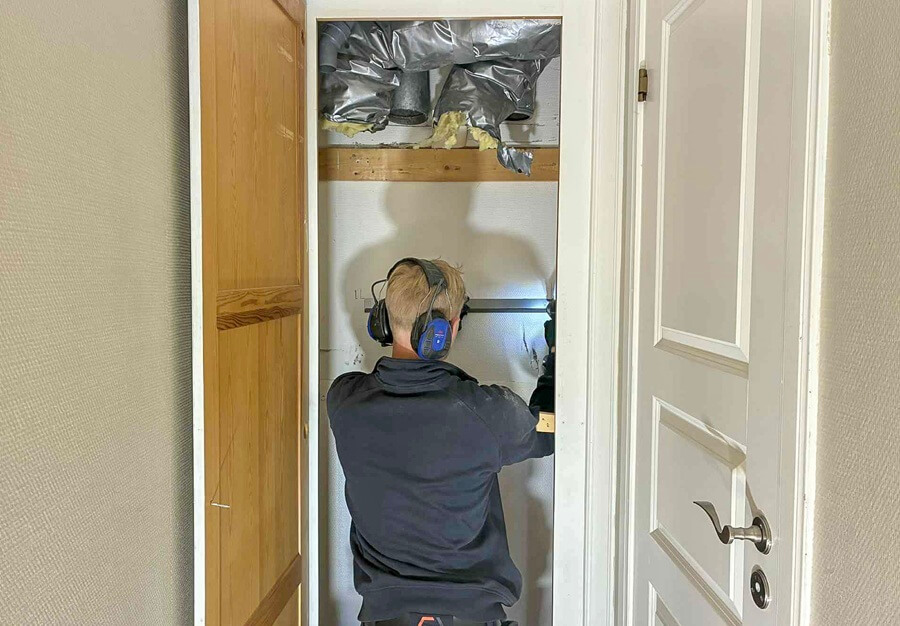
What Does HRV Ventilation Cost? Price Examples for Villas and Houses

Table of contents
This article is a translated version and is only relevant in Sweden.
FTX ventilation is a ventilation system that both improves indoor air quality and recovers heat from exhaust air. FTX stands for extract and supply ventilation with heat recovery, which means that old air is taken out while new, filtered air is taken in.
In a For a standard-sized detached house, FTX ventilation often costs around 80,000–160,000 SEK before the ROT tax deduction and any grants available through the Villaeffekten scheme. The price is affected by the size of the house, floor plan, number of floors, ductwork, unit placement and which FTX unit is chosen.
There is therefore no standard price that fits all houses. An FTX system is customised to the conditions of the house, and two houses with the same living space can have different prices depending on how easy it is to place the unit and run ventilation ducts.
What Is the Cost of HRV Ventilation in a Normal-Sized House?
For a detached house of about 120-160 m², a common benchmark is approximately 80,000–160,000 SEK before the ROT tax deduction and, where applicable, the ‘Villaeffekten’ for a complete FTX system with installation. In simpler houses with good conditions, the price can be closer to SEK 70,000-130,000, while more difficult installations can be significantly more expensive.
- Only one FTX residential unit: approximately SEK 25 000-60 000
- Material package or kit for FTX systems: approximately SEK 50 000-80 000
- Complete FTX ventilation with installation: approximately 80,000–160,000 SEK before the ROT tax relief and, where applicable, the Villaeffekten
The wide range is normal. The price is influenced not only by the unit, but also by the ducting, sound attenuation, insulation, drilling, adjustment and the amount of work required in the house.
Here you can read more about the actual installation of FTX unit in villa or house.
| Part of the cost | Estimated price | Commentary |
|---|---|---|
| FTX unit | SEK 25 000-60 000 | The price is influenced by capacity, noise level, control, efficiency and make. |
| Ducts, ducts, silencers, insulation and other materials | SEK 20 000-45 000 | Material costs increase with more storeys, longer ducting and higher sound attenuation requirements. |
| Installation, drilling and alignment | SEK 35 000-70 000 | Labour costs vary most depending on the construction of the house and how easily the ducts can be laid. |
| Total cost before ROT and the Villaeffekten scheme | 80 000-160 000 SEK | A realistic benchmark for many existing villas. |
What Is the Cost of the Unit Itself?
Many people start by searching for ”FTX unit price”, and that is perfectly reasonable. But this is also where it is easy to get a skewed picture of the total. The actual The FTX unit is the ”heart” of the system, but still only part of the overall system.
For a detached house, the unit is often around SEK 25 000-60 000. A smaller model for a smaller house is closer to the lower end of the range. If you need higher capacity, better control, lower noise levels or a unit suitable for a more demanding installation, the price will be higher.
A cheaper unit does not always mean a cheaper system in the long run. If the unit is incorrectly dimensioned, makes too much noise or requires more complicated ducting, the total cost may still be higher.
Price example of Acetec EvoAir FTX units suitable for residential use:
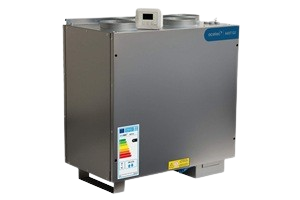

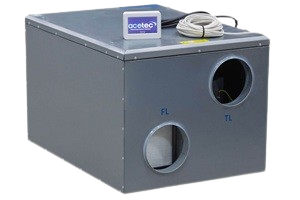
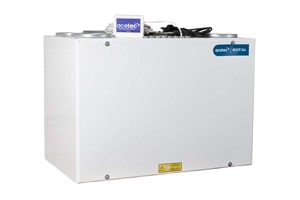
The important thing is not to confuse price of the unit with price of a ready-made FTX system. A good unit without the right ducting, soundproofing and adjustment does not give the result you want.
Price of HRV Ventilation: What Is Really Included?
When comparing the price of FTX systems, it's smart to start with the question: what is actually included?
A quotation may look cheap on the first line, but still be expensive in the end if important elements are added later. That's why it's good to read the quote more like a table of contents than just a final amount.
- Project planning: how the system should be sized and routed in the house.
- FTX unit: the unit that manages ventilation and heat recovery.
- Channels: the pipework that carries supply and extract air through the house.
- Supply and exhaust air devices: the valves where air enters and exits.
- Silencers: is often needed to make the system feel quiet and comfortable.
- Insulation: especially important if ducts are laid in colder areas.
- Roof hood, wall grilles and penetrations: details that often affect both price and time.
- Assembly and drilling: a large part of the labour cost in many projects.
- Adjustment: fine-tuning of airflows so that the system works properly in each room.
Please feel free to request a quote in which the equipment, materials, labour, drilling, alignment, travel and any optional extras are clearly itemised. This will make it easier to compare different quotes fairly – and to see which costs may be covered by the ROT scheme and the Villaeffekten scheme respectively.
What Influences the Price of an HRV System the Most?
When someone asks how much FTX ventilation costs, it is often the conditions of the house that determine the price. It is rarely the unit alone that makes the biggest difference. Often it is the ductwork and the work around it that makes the difference.
Here are the most common things that make the price go up:
- Two-storey house or difficult floor plan: longer ducting and more work.
- Concrete walls or concrete floors: punching becomes more time-consuming and more expensive.
- No clear location for the unit: If there is no attic, boiler room, technical room or laundry room, the solution is often more complicated.
- Concealed ducting: often gives a neat result, but requires more labour hours and more recovery.
- High requirements for low noise levels: may require more silencers and more careful planning.
- Long duct runs: may involve larger ducts, more insulation or larger units.
- Finished house with some work space: it is almost always more expensive than doing the installation during renovation or remodelling.
In some houses, it is possible to keep costs down by accepting a more visible but neat routing of some ducts. In other houses, a more hidden result is worth the extra cost. It comes down to what is most important: price, appearance, noise level, service access or minimum impact on the house.
ROT tax relief and the ‘Villa Effect’ for FTX ventilation
An FTX installation may be eligible for both the ROT tax relief and the government grant The Villa Effect. The installation of FTX is one of the measures covered by the Villaeffekten scheme.
The ‘villa effect’ can contribute to up to 30% of the cost of eligible materials, including VAT, up to a maximum of 60,000 SEK per detached house. In 2026, the ROT tax relief will be up to 30% of the labour cost forming the basis for ROT. As the Villa Effect applies to materials and the ROT scheme applies to labour, they can be combined, provided that the conditions for each scheme are met.
| Example | Total price | Eligible material | Pioneering work in the field of ROT | The Villa Effect | ROT | Estimated final cost |
|---|---|---|---|---|---|---|
| Example 1 | 100,000 SEK | 60,000 SEK | SEK 40 000 | 18,000 SEK | 12 000 kr | 70,000 SEK |
| Example 2 | 150,000 SEK | 90,000 SEK | 60,000 SEK | 27,000 SEK | 18,000 SEK | 105,000 SEK |
In the first example, the calculation is therefore 100,000 − 18,000 − 12,000 = 70,000 SEK. In the second, it is 150,000 − 27,000 − 18,000 = 105,000 SEK.
The examples assume that the entire stated cost of materials is eligible for a grant, that the labour costs qualify for the ROT scheme, and that you have sufficient ROT allowance. The actual grant may therefore be lower. The Villaeffekten grant is not paid out if the grant amount is less than SEK 10,000, which means that the eligible material costs must be at least SEK 33,334.
To qualify for the Villa Effect, you must, amongst other things, own and live permanently in a detached house, the house must have been built before 1990, and it must not already be connected to a district heating network.
The ROT tax deduction is capped at 50,000 SEK per person per year. The combined total of ROT and RUT deductions may not exceed 75,000 SEK per person per year.
Find out more about which properties and materials are covered, how the application process works and all the conditions in our guide to The Villa Effect.
Here you can also read more about ROT tax relief for ventilation and installation.
How Much Can You Save with HRV Ventilation?
In the case of self-draught or only mechanical exhaust air, warm indoor air is ventilated out without the heat being utilised. New outdoor air then needs to be heated again. With FTX, a large part of the heat in the exhaust air is recovered and transferred to the incoming supply air.
Modern FTX units can often have a temperature efficiency of around 75-85%, but this does not mean that you automatically save 75-85% in money. The actual savings are influenced by factors such as fan speed, reheating, filter status, air flows, adjustment and the type of heating in the house.
The amount of savings depends on several factors: the size of the house, air flows, climate zone, previous ventilation solution, efficiency of the unit, electricity consumption of the fans and the type of heating. One thing that is often forgotten in the energy calculation is the SFP value. In simple terms, SFP shows how much electricity the fans need to move the air in the system. A lower SFP value means that the ventilation can be operated more energy efficiently, which affects the net savings over time.
It is therefore important to distinguish between theoretical heat recovered and actual financial savings. An FTX system can reduce heat loss through ventilation, but the actual savings in monetary terms depend on how the house is heated and how the system works in practice.
Example Calculation – Villa of 150 m²
Let's take a villa of 150 square metres as an example. A common way of estimating ventilation flow is to assume about 0.35 litres per second per square metre. For 150 m², this corresponds to about 52.5 l/s, or about 190 m³/h.
0.35 is thus used to calculate the air flow. Once the air flow is calculated, 0.33 is used to estimate the heat loss. 0.33 is a simplified factor for the heat content of the air and corresponds approximately to the energy required to heat 1 m³ of air by 1 degree.
A simple rule of thumb for ventilation loss is:
0.33 × air flow in m³/h × temperature difference = power loss in watts
If we assume 190 m³/h and an average temperature difference of 12 °C, the power loss is approximately
0.33 × 190 × 12 = approximately 750 W
In simplified terms, recalculating this over large parts of the year corresponds to about 6 500 kWh of ventilation loss per year without heat recovery. As temperature, climate and actual operating time vary, it is more reasonable to see this as a simplified range, for example around 5 000-6 500 kWh per year.
| Example value | Level | Commentary |
|---|---|---|
| Boyta | 150 m² | Normal-sized villa. |
| Ventilation flow | approximately 190 m³/h | Equivalent to approximately 0.35 l/s per m². |
| Ventilation loss without recovery | around 5 000-6 500 kWh/year | Simplified estimate depending on climate, temperature and actual operation. |
| Theoretical heat recovered at 75-85% temperature efficiency | approximately 3 750-5 500 kWh/year | Before taking into account fan power, reheat, filter status and actual operation. |
| Possible reduction of heat demand after actual operation | about 2 500-4 500 kWh/year | Can be both lower and higher depending on the house, system, adjustment and heating. |
At an energy price of €2/kWh, 2,500-4,500 kWh is roughly equivalent to €5,000-9,000 per year. But let's be honest: it's not always the same as straight money.
If the house has direct-acting electricity, the calculation is quite straightforward. Each kWh of heat saved directly affects the cost of electricity. If the house has district heating or other purchased heat, the savings depend on the price of heat. However, if the house has a heat pump, the financial savings are often lower, as the heat pump already produces several kWh of heat per kWh of electricity purchased. In this case, FTX can still reduce the heating demand, but the costs and payback time need to be calculated more carefully.
There are also cases where the previous ventilation was too low. In these cases, a new FTX system can provide better air and more even flows, but the energy savings will not be as clear because the house is actually ventilated more correctly after installation. This is not necessarily a bad thing. It just means that you get more ventilation, better control and heat recovery at the same time.
In addition to the immediate energy savings, an FTX system offers several long-term benefits. You get filtered supply air, a more even temperature, less cold draughts and a better balance in the house through controlled and adjusted air flows.
⚠️ The actual savings of the FTX system always depend on the conditions of the house - insulation level, climate zone, air flows, tuning, temperature efficiency, SFP value, fan power and how the ventilation worked before. For a more precise assessment, an individual audit or energy calculation is required.
How Much Does HRV Cost to Run?
In addition to the installation cost, there are some running costs to consider. An FTX system uses electricity to power the fans and the filters need to be changed regularly. The frequency of filter changes depends on the unit, air quality, filter type and operation, but many homeowners change filters once or twice a year.
A dirty filter can result in poorer airflow, higher noise levels and higher energy consumption. Therefore, it is filter byte and regular maintenance are essential to keep the system working effectively.
It may also be wise to have the system checked and, if necessary, adjusted after a few years, especially if you have remodelled, changed the diffuser, changed the floor plan or are experiencing noise, draughts or uneven air flows.
The running costs therefore vary between different houses and units. Take into account, in particular, filters, fans and any service visits over time.
When Is It Best to Install HRV?
The best time to do this is often when you are doing something major in the house. If you're renovating the attic, replacing the ceiling, rebuilding, installing new electricity or opening up walls, it's almost always easier to get good ducting at the same time.
This does not mean that FTX cannot be installed in a finished house. It is often possible. But in many cases the price will be better if the installation is coordinated with other work.
Another good time is when you are reviewing the energy performance of your house. If you have already replaced windows, added insulation or sealed the house, ventilation can become even more important. A more airtight house needs controlled air exchange for the indoor environment to function properly.
Contact Us for a Quote
If you want to know what FTX ventilation actually costs in your particular house, the next step is to get a real quote. We work with certified installers and are happy to help you find a solution that suits your house's living space, floor plan and existing ventilation.
Contact us below and we will match you with a certified installer we work with. Please include living space, number of floors, whether the house has an attic or technical room. Then the price picture will be more accurate immediately.
Get a quote for the installation of FTX ventilation:

